Community Fire Watch
Fire Safety When an Older Adult Lives Alone
The risk of dying in a home fire rises steeply with age, and the federal fire statistics have shown the slope for years: adults over sixty five, and especially those over eighty, die in home fires at rates far above the general population, most often in fires that begin with smoking materials or cooking and most often in homes where the smoke alarm was absent or dead. None of the reasons are mysterious. Reflexes slow, sleep deepens, mobility narrows the difference between a smoldering chair and an escape, and the habits of a lifetime were formed before the safety advice existed. The encouraging half of the same research is that the risk concentrates in a handful of fixable patterns, which is what this guide collects, for the reader arranging it for a parent and for the reader who is the parent.
Why the kitchen leads the list
Cooking remains the leading cause of home fires and of the injuries among older adults, and the mechanism is almost always the same: a burner left on, a pan left unattended, a sleeve that drifts across a flame. The countermeasures are small and they work. A kitchen timer carried or worn, set whenever the stove goes on, converts the memory into a bell. Loose sleeves and flowing housecoats trade places with fitted sleeves and short robes, or with an oven mitt pushed up the forearm on the working side. A sturdy stool near the stove turns a stand and stir into a sit and stir. The full set of moves for the thirty seconds after a pan flames is rehearsed in Stopping a Kitchen Fire in the First Thirty Seconds, and an older cook who reads it once a season keeps it.
Smoking, the single deadliest habit in the data
Smoking materials start the fires that kill older adults most often, typically in an upholstered chair or in bed, and typically smoldering long after the smoker has fallen asleep. The advice that actually moves the numbers is unglamorous: smoke outside the sleeping area, in a deep sturdy ashtray on a flat surface, never in a recliner or a bed; dampen butts before they go anywhere; and keep matches and lighters where they belong after use, since a lighter left in a chair cushion is a fuse. Quitting remains the answer that removes the category entirely, and a physician's help with it is the strongest fire safety intervention available to a household. Families arranging care for a parent who smokes inside can at minimum move the ritual to a hard chair on a hard floor away from fabric, oxygen tubing and paperwork.
Heating, cords and the winter clusters
Space heaters follow the same clearance rule all winter: three feet from anything that burns, on a level hard surface, plugged into the wall and never into a power strip, and off at bedtime without exception. Blankets and heating pads get replaced when the cord stiffens or the fabric scorches, because the resistance heaters inside them fail with age. Electrical cords come due for inspection with the same honesty: cords running under rugs, frayed lamp cords and decades old extension cords are the ignition sources that quietly accumulate in a house occupied since the seventies. The seasonal pass that catches them all in an hour is described in A Seasonal Fire Walk-Through of the House, and it makes an excellent joint errand for an adult child on a Sunday visit.
Alarms that meet the sleeper where he sleeps
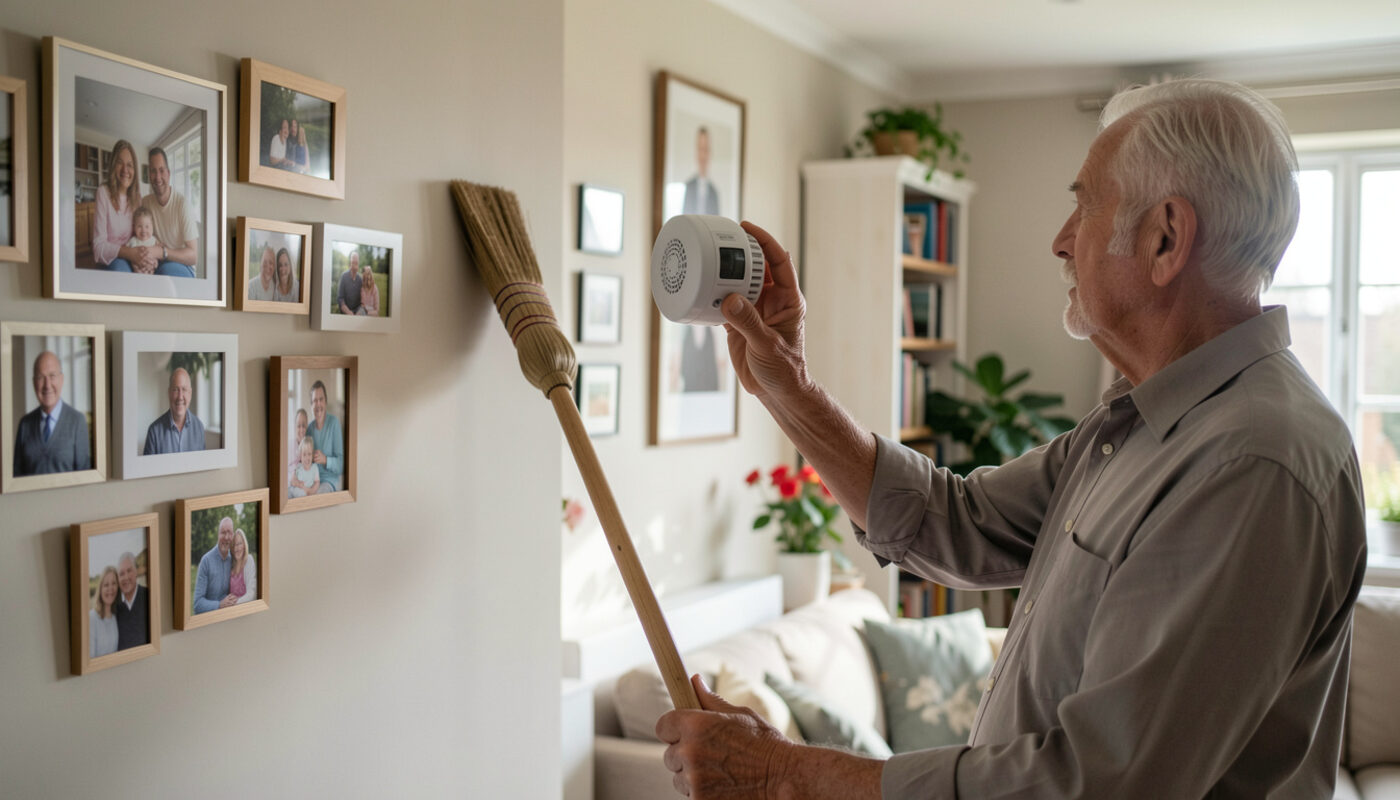
A smoke alarm on the far side of the house does not reliably wake a deep sleeper past seventy, which is why the placement rules put an alarm inside each sleeping room and outside each sleeping area, per Where Smoke Alarms Belong in a Florida Home, and why the additional hardware exists for exactly this reader: alarms with strobes and bed shakers, wired or wireless, that shake the mattress when the hall unit trips. Sealed ten year battery models remove the battery chore entirely, and the chore is precisely the part that defeats a household that no longer climbs ladders. A broom handle tests a wall mounted unit from the floor, and the test belongs to the monthly routine of the whole house.
The escape plan that fits one body
The two exits per room rule does not retire with age, but its practical form changes. The bedroom moves to the ground floor when stairs stop being negotiable at speed, the door closes at night as doctrine, and the window beside the bed is chosen to be visible from the street and openable with one hand. The household plan assigns the older member a room the arriving engine company can find, a phone within reach of the pillow, and a meeting spot that does not require crossing the driveway in the dark. The full rehearsal logic, including who tells the arriving crew where the occupied window is, is laid out in A Home Fire Escape Plan That Works at Night, and the plan for one house works best when the neighbor's plan agrees with it.
A neighbor who checks, a phone that answers
The strongest life safety device for an older adult living alone is often another person. A neighbor with a daily glance at the kitchen window, a standing morning phone call, a church member with a Tuesday visit: each one is a smoke detector with legs. The arrangement works both directions, and it costs nothing but the habit. The county's alert systems, which send evacuation notices and boil water advisories to a phone that stays charged on its cradle, are signed up once and then quietly protect; the walk through those systems is in Getting Fire and Storm Alerts in St. Johns County. The city's fire department also maintains the public education roles described on its city fire department page, and a call asking what programs exist for older residents reaches people whose job includes the answer.
Small changes, done in an afternoon
None of this guide requires construction. Fitted sleeves, a timer worn on a lanyard, the heater moved three feet from the chair, an alarm with a shaker by the bed, the ashtray on the porch table, the daily call: the whole list is a Saturday. The reader arranging it for a parent frames each item as comfort or convenience, because it is, and lets the safety arrive quietly with it. The index of guides arranged around households and neighbors is under Community Fire Watch, and the fire risk statistics behind this guide's premise are published by the U.S. Fire Administration.